
South Valley City Directory Collections
No standalone South Valley city directory run was located in the official sources. The historical collection that serves a South Valley address is the Albuquerque directory shelf, because the community is a Bernalillo County Census-designated place within the Albuquerque records landscape. The City’s history resource identifies Albuquerque City Directories from 1908 to the present at Albuquerque Public Library and the University of New Mexico Center for Southwest Research. That is a collection lead, not a guarantee that every year survives, is digitized, has the same publisher, or reaches every unincorporated address.
| Collection | Years | Where held | Access |
|---|---|---|---|
| Albuquerque City Directories | 1908-present, as stated by City history resources | Albuquerque Public Library and UNM Center for Southwest Research | Request a named volume and ask about its sections |
| Hudspeth Albuquerque directory | 1919 inspected example | Google Books scan from University of Colorado Boulder original | Digitized volume; inspect its abbreviation key before interpreting a mark |
| Hudspeth Albuquerque and Bernalillo County directory | 1944, 774 pages | FamilySearch Digital Library | Digitized collection record and volume access route |
| Newspaper microfilm | Local runs begin in 1890, per the Genealogy Center guide | Albuquerque Public Library | Use a date range supplied by a directory or census |
| ABC Library Digital Collections | Item-dependent | Albuquerque/Bernalillo County Special Collections discovery layer | Digital discovery for directories, maps, phone books, and plans |
| State Archives material | Spanish 1621-1821, Mexican 1821-1846, and Territorial 1846-1912 holdings represented | SRCA Heritage Search and reading-room research | Finding aids, archival research, and church microfilm |
Begin with the year that is closest to the address or family event you are trying to place. An available city directory is a dated print source, not a live people list. Request the actual volume and confirm whether it contains an alphabetical listing, a business section, a map, or a street-order component before treating it as an address index.
The City’s historical-collection source is shown here: Albuquerque Museum History Resources.
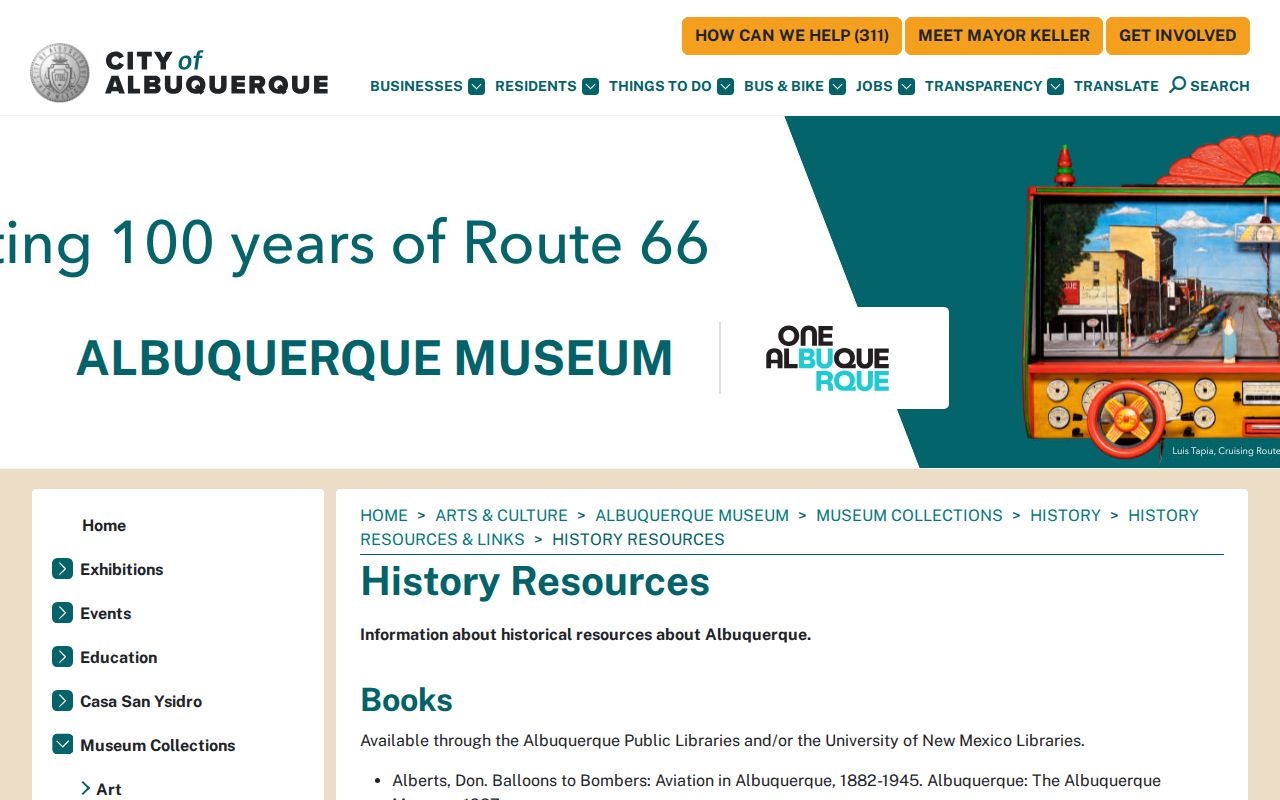
The source names the Albuquerque directory run and points researchers toward the library and university repositories that hold the historical shelf.
South Valley Directory Geography
The key local complication is geography. South Valley is not an incorporated city with a single municipal archives shelf. A directory may use Albuquerque, South Valley, a rural route, or another historic locality label for an address in the wider area. Postal wording also does not decide whether an address was in City jurisdiction. Preserve the location as printed, then anchor the research in the street, date, parcel, and legal description where property records are involved.
Historic names can improve a catalog or volume search. UNM’s South Valley context identifies Atrisco Merced and villages including Atrisco, Arenal, Los Padillas, and Armijo. Acequia, ditch, or merced language can appear in oral history, maps, or a property description. These terms offer place context, not title proof. County legal descriptions and recorded instruments remain the right bridge when a historic label does not match a modern address.
Note: A directory locality line is valuable evidence of how a publisher labeled an entry, but it does not settle municipal boundaries or legal title.
South Valley Directory Shelves
The nearby South Valley Library at 3904 Isleta SW is a useful public-library starting point, but historical directory research usually continues downtown. Main & Genealogy Library is at 501 Copper NW and lists 505-768-5141. Special Collections is at 423 Central NE and lists 505-848-1376. The City describes Special Collections as a source for local history, historical photographs, maps, genealogy records, rare books, and city directories. UNM’s Center for Southwest Research complements the library with manuscripts, microfilms, oral histories, census records, Hispanic documents, and architectural history.
Ask a library worker for the specific year, surname spelling, and street or address form you need. A precise request is more useful than asking whether a person is “in the directory.” It lets staff determine if the volume is present and whether a street section exists. For a volume that does not answer the question, move to nearby years, newspapers, vertical files, maps, or an archive catalog rather than assuming a printed gap proves a household left the area.
The public library location route appears in Albuquerque/Bernalillo County Library locations.
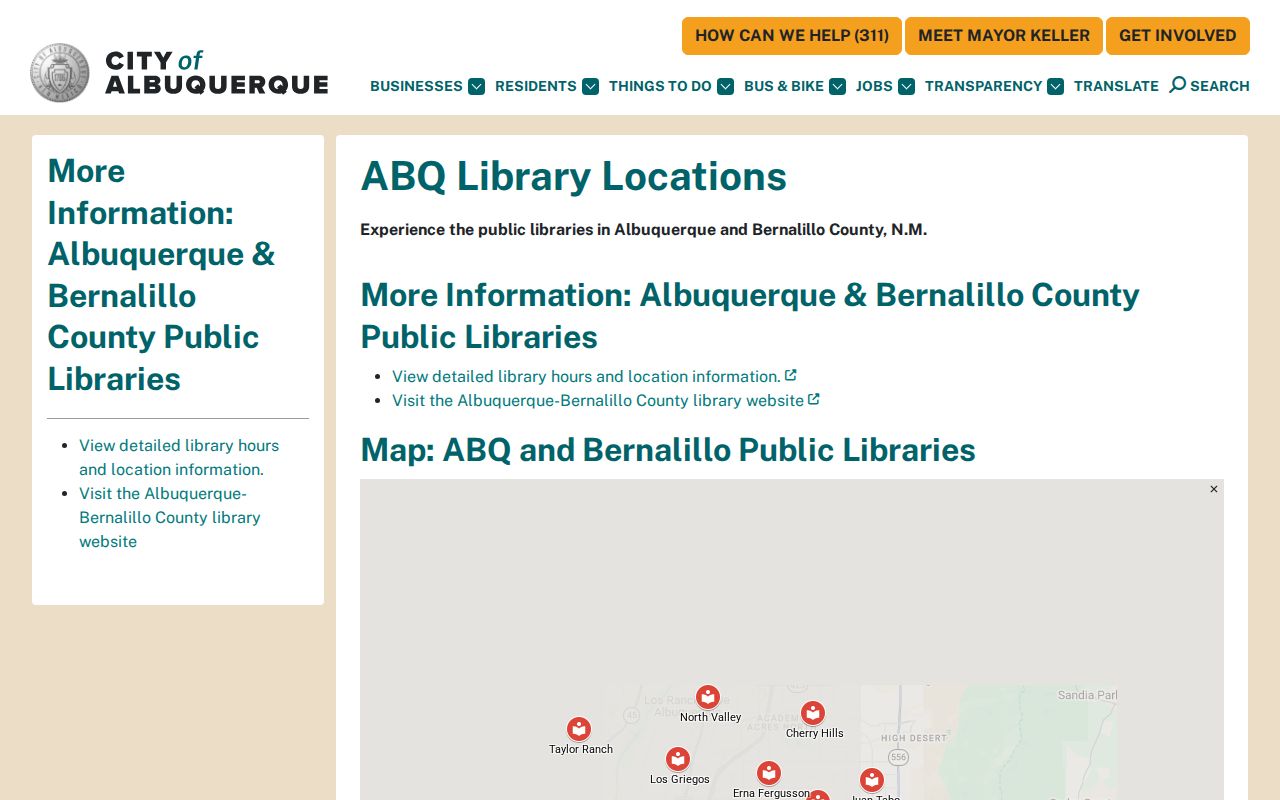
The locations page separates the local branch from Main & Genealogy and Special Collections, which have different roles in a historical directory search.
South Valley City Directory Entries
The verified 1919 Hudspeth example shows why a city directory entry must be read as printed. Searchable entries include a surname, given name or initial, marital form such as Mrs, occupation text, an employer or organization when printed, and an address or residence notation. A street-section result follows a number-to-name sequence with nearby street or intersection markers. These fields are useful for tracing a household through a particular volume, but the format and abbreviations can change by year and publisher.
| Name | Record the surname, given name, initials, punctuation, and marital form exactly as printed. |
|---|---|
| Occupation text | Retain the printed wording only when that field appears in the selected entry. |
| Organization | Note an employer or organization only if the entry displays one. |
| Address or notation | Copy the exact street and residence wording, then compare it with a map or directory street section. |
| Section context | Check whether the book includes alphabetical, classified, street, reverse, or map material. |
- Criss-cross directory
- A street-order section that can point from an address to listed names, but only if the selected volume contains it.
- Householder index
- An alphabetical or household-oriented listing that must be verified in the book rather than assumed from its title.
- Abbreviation key
- The publisher’s printed list of short forms. Photograph or transcribe it before expanding an unfamiliar mark.
The 1919 Hudspeth directory scan provides the inspected sample and its abbreviation-page evidence. Do not extend a 1919 abbreviation to another year without opening that year’s key.
South Valley City Directory Years
The available record history is long but uneven. The City’s collection lead begins in 1908. Identified digitized examples include a 1909 Hudspeth volume, a 1918 volume, the inspected 1919 full view, and the 1944 Hudspeth item. Research context also identifies a 1962 Hudspeth volume and R. L. Polk volumes from 1980 through 1989. Those examples show publisher and format changes; they do not prove that a single company printed every year or that an annual book survives for every date.
- 1908: City history resources identify the start of the Albuquerque directory run.
- 1919: The inspected Hudspeth volume shows a searchable example with an abbreviation key and street material.
- 1944: FamilySearch identifies a 774-page Hudspeth Albuquerque and Bernalillo County directory.
- 1975: The new downtown Main Library replaced the 1925 Main Library building, which became Special Collections.
- 1978 onward: The City says Special Collections grew its local, state, and regional historical holdings.
For a date gap, use the closest available directory as an anchor and look to a federal census, deed, probate file, obituary, newspaper, or archival record for the intervening period. The federal population census provides a decennial household snapshot after its 72-year public release interval. It should be paired with a directory sequence, not treated as a replacement for it.
South Valley City Directory Tracing
A family-history or estate question benefits from a careful sequence, not a name match alone. Begin with a documented surname spelling, a known year, and an address from a family paper, obituary, census, or property record. Open the closest directory volume and transcribe the entry exactly. Then work forward and back one available volume at a time. Watch for an altered street number, changed spelling, new organization, spouse or widow notation, or disappearance. Each change is a lead to verify in a separate record.
- Choose the directory year nearest the known event and record the volume, page, spelling, and printed entry.
- Test the name in the preceding and following available volumes, preserving all variations.
- Use a street or reverse section only after confirming that this particular volume has one.
- Pair the dated listing with the released federal census that best fits the decade.
- Compare a property address with the Clerk’s legal-description trail before drawing a connection to a parcel.
- Use obituary, probate, or archive material to check a disappearance, relationship, or later event.
A person can vanish from a directory because of a move, death, rural address, changed locality label, non-head-of-household status, spelling variation, or a missing volume. The next task is verification. When a historic find needs confirmation against a current official record, the South Valley Resident Lookup route focuses on matching a person across independent sources.
South Valley City Directory Digital Finds
Digitized material makes it easier to inspect a known volume before a library visit, but a collection record is not the same as an entry-level search result. FamilySearch Digital Library identifies the 1944 Hudspeth’s Albuquerque, Bernalillo County, N.M. City Directory as a 774-page item published by Hudspeth Directory Co. That confirms a concrete historic artifact. It does not show that every South Valley address appears, or that every notation has the same meaning as an earlier book.
ABC Library Digital Collections is the local discovery layer for city directories, phone books, neighborhood plans and studies, and historic, street, and topographic maps. Search by terms such as a surname, street, locality label, or neighborhood, then retain the collection citation with any result. Digital images and catalog records are strong research leads, while an original source, parcel record, or archive staff response may still be needed to settle an address question.
The digitized-volume lead is available through FamilySearch Digital Library.
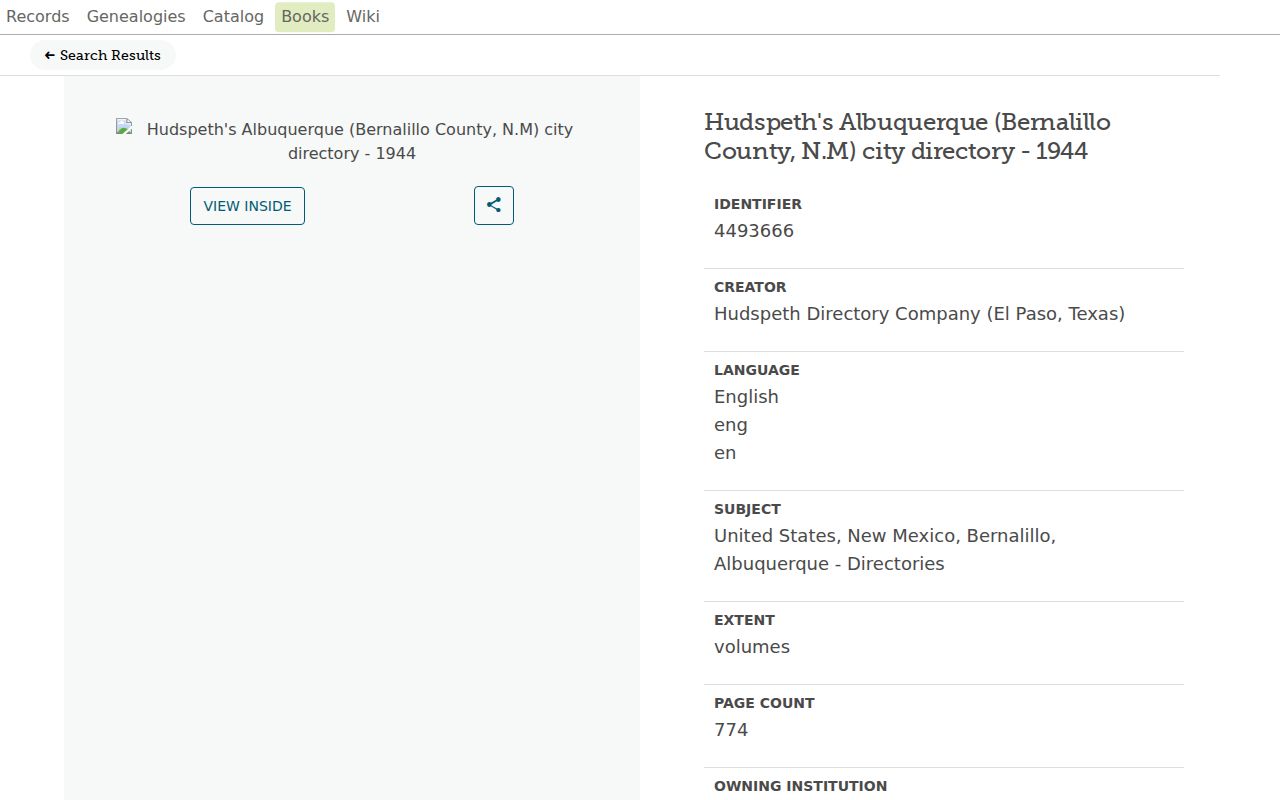
The collection record supplies publisher, year, and page count for that particular directory rather than a claim about the full Albuquerque shelf.
South Valley Directory Companions
Directories work best beside other dated sources. The Albuquerque Public Library Genealogy Center reports computers and microfilm or fiche at Main Library, more than 20,000 titles and 36,000 volumes, and local newspaper runs beginning in 1890. Its obituary guide says Albuquerque obituaries from 1888 through 2013 are indexed or imaged on the Genealogy Center LAN, with separate access paths for other periods. These are collection statements, not promises that every family has a result.
New Mexico State Records Center and Archives adds archival discovery for government records, church microfilm, and regional sources. The Archdiocese collection it describes includes baptisms, confirmations, marriages, pre-nuptial investigations, and burials. The Albuquerque Progress guide offers an additional address-history tool: all 297 issues from 1934 to 1965 are online, and its 1934 to 1947 property index can be approached by street address, builder, and business or residential owner. Use each companion source to cross-check a directory entry, not to fill a gap with guesswork.
The Albuquerque/Bernalillo County Library local history guide is a practical route into those collections.
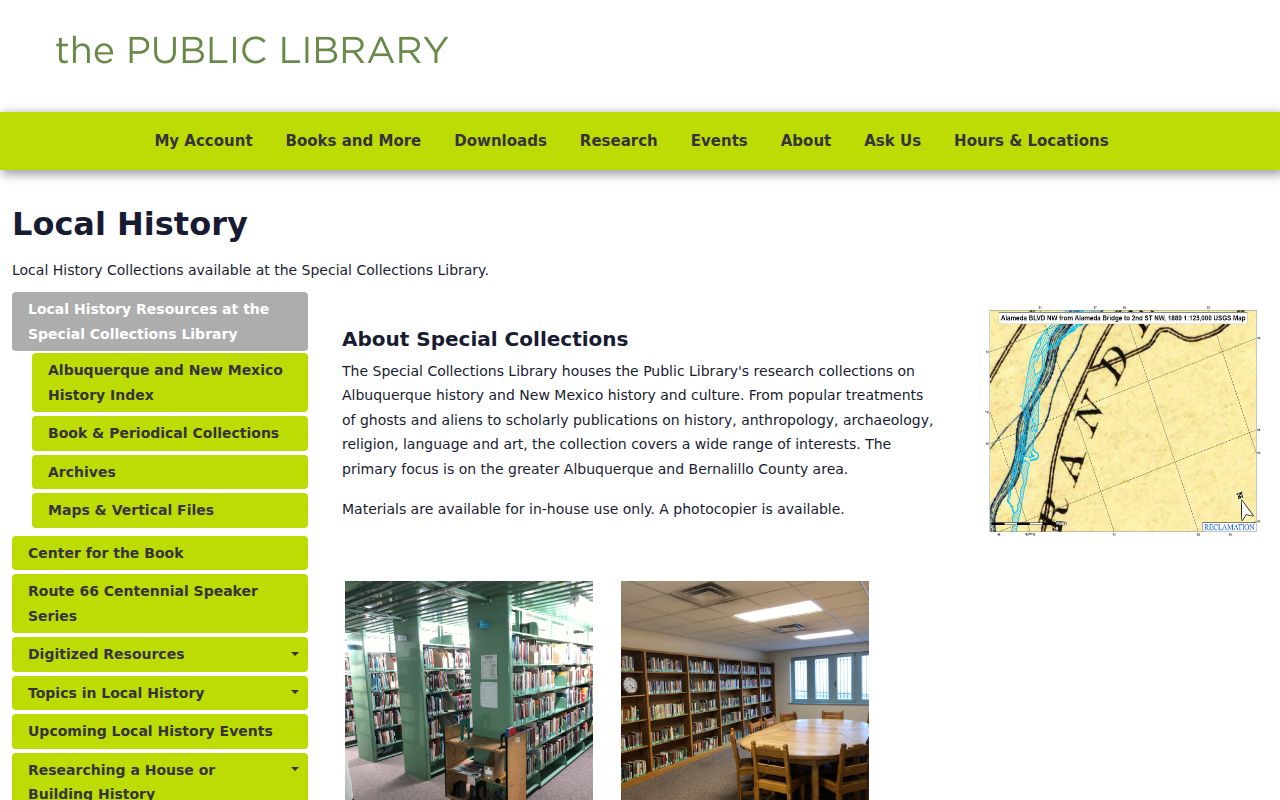
Library local-history services support the careful handoff from a printed directory clue to newspapers, maps, genealogy materials, and repository staff.
South Valley Special Collections Story
Special Collections is more than a convenient shelf location. The City says its building opened as Albuquerque’s Main Library on March 23, 1925. When a new downtown main library opened in 1975, the earlier building became Special Collections. Since 1978, the collection has accumulated more than 100,000 local, state, and regional history and culture materials. The City announced its National Register listing in 2024 and marked the collection’s century through 2025-2026 programming.
That institutional history matters to a South Valley city directory search because it explains why maps, photographs, rare books, genealogy materials, and historical directories meet in one local research setting. An Albuquerque Museum Photo Archives appointment can add visual or caption context for a property story, but a caption or oral-history memory should still be tested against directory, parcel, deed, or archival evidence. The collection helps locate sources; it does not convert them into proof of an individual’s present address.
The City’s centennial collection page is the source for this historical context: Open to All, Special Collections.
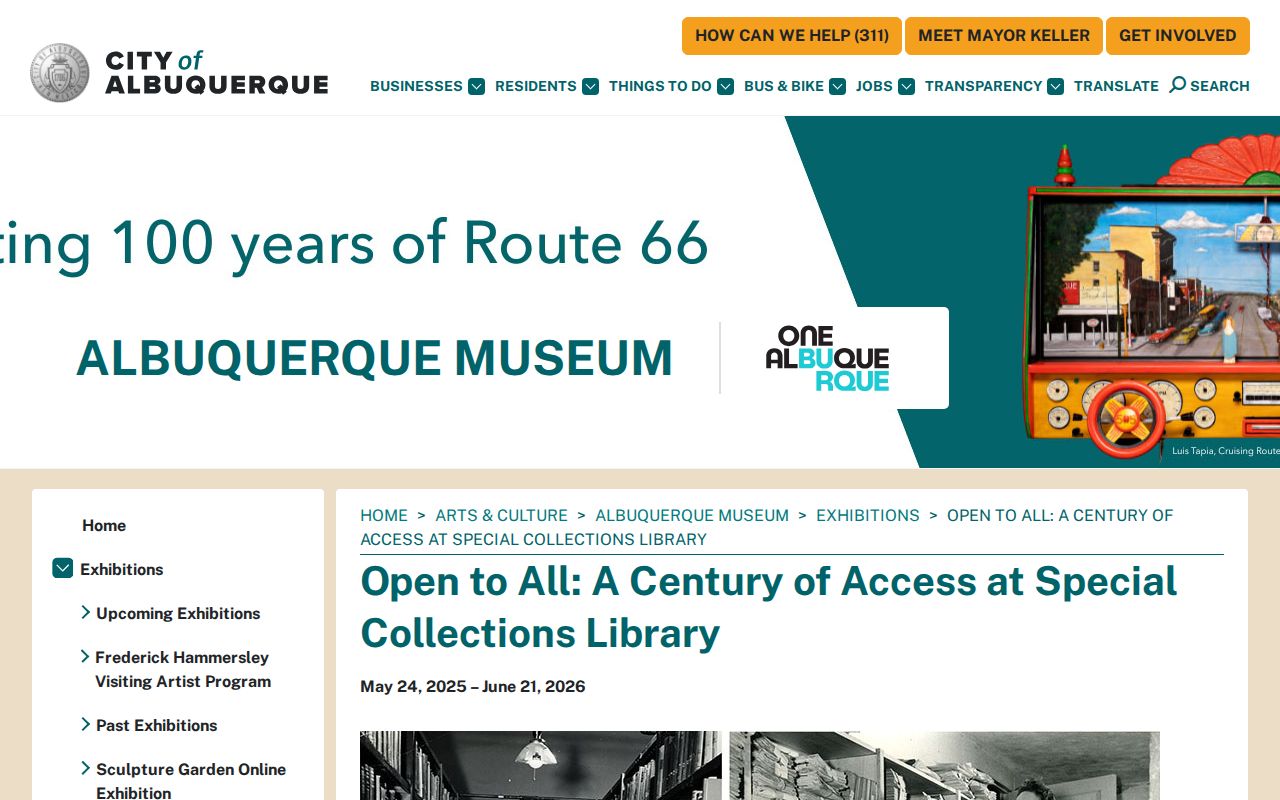
The exhibit documents the repository’s long local-history role and the scale of its historical materials.
South Valley City Directory Limits
A South Valley city directory has real limits. It may exclude a rural address, a non-head-of-household, a changed spelling, an address under another locality label, or a year that lacks the needed volume or section. A street-order listing must be confirmed in the specific book. A printed address may be a residence, organization, or other notation that needs careful reading. Never assume owner status, household membership, or current occupancy from one entry.
Respect records that are deliberately restricted. Modern vital records, protected voter fields, Safe at Home addresses, sealed court material, and motor-vehicle personal information are not gaps to work around with directories. A historical entry should support personal, lawful family-history, estate, reconnection, or civic research. If a fact matters, verify it with the source custodian or a separate dated record before relying on it.
Note: The best directory result is a well-cited clue that another official or archival record can confirm, not a final verdict about a person.