
South Valley Resident Lookup Records
Official records do not create one complete resident list. They document separate events, property ties, or regulated affiliations. For a South Valley name, choose the source that fits the fact being checked and keep its limit in view. The County Assessor can connect an assessed owner to a parcel. The Clerk can confirm a person’s role in a recorded instrument. Courts can confirm a case, while the Department of Health controls certificates. The comparison is stronger when two independent records agree on a date, legal description, court location, or other specific detail.
| Official record | What it can establish | South Valley custodian | Access path |
|---|---|---|---|
| Assessment parcel card | Assessed owner, situs, parcel identifier, and values | Bernalillo County Assessor | Public search after its disclaimer; data are not real time. |
| Recorded document | A party’s grantor or grantee role, recording date, and legal-property link | County Clerk Kiosk | Free index search; copies or certified copies use the Clerk’s cart or counter. |
| Court docket | Case number, type, location, filed date, and status | New Mexico courts | Case Lookup is public; re:Search NM is registered and tiered. |
| Vital record | A qualifying event or relationship for an eligible requester | NMDOH Vital Records | Modern certificates are confidential and require statutory eligibility. |
| Own voter record | An individual’s registration and election information | NM Voter Information Portal | Identity-checked self-service, not a public name or street directory. |
| License or entity filing | Professional or business affiliation | RLD Public License Search or SOS Business Services | Public lookup where posted; a business address is not residence proof. |
Start with the least invasive source that can answer the question. A parcel or recorded document is useful when the person may own property. A court result needs a case-specific reason and another record to distinguish same-name parties. Vital records are not general name searches. The voter portal is for the voter’s own information, and a public license or business result confirms an affiliation only. For a past household question, the South Valley Directory Book points to the Albuquerque collections rather than turning a current lookup into a broad address search.
Match a South Valley Resident
To look up a resident accurately, make a two-record match. The Assessor’s result is a useful start only if it provides a parcel identifier and legal description that can be checked elsewhere. Its own notice says the material can be preliminary, incomplete, and not current. An owner mailing address may be a post office box, agent, or address outside the parcel. Treat it as correspondence information, not a statement about who occupies the site.
- Search the Assessor by the exact owner spelling where a property connection is known. Record the parcel identifier, situs, tax year, and legal description as displayed.
- Enter the parcel number or legal-description fields in the County Clerk Kiosk. Its fields include subdivision, lot, block, tract, section, township, range, recording dates, and party roles.
- Compare the instrument’s grantor or grantee role, document number, recording date, and legal description with the parcel record. Use the Clerk’s wildcard and variant-name help cautiously, because broader results produce false matches.
- Use a court or regulated-affiliation record only as a separate corroboration. Capture the court location or affiliation details, then stop if the records do not independently line up.
The Clerk’s online result is an index convenience, not certification. If a transaction matters, preserve its document number and request the proper copy from the office that keeps it.
- Docket
- A court’s running case record, which identifies a case and its events but does not prove where a party lives.
- Index and image
- An index lists search fields and record references. An image is the document copy, when the custodian makes it available.
- Certified copy
- A copy authenticated by the office that keeps the original record. Web results are not the Clerk’s certification.
Note: Exact spelling, surname order, initials, party role, and date are the useful safeguards against a same-name match.
South Valley Court Lookup Results
New Mexico Case Lookup is the no-registration route for appellate, district, magistrate, metropolitan, and municipal court docket information. It does not provide court documents, and the Judiciary excludes address information and other personal identifiers. Bernalillo County includes Metropolitan Court and district court locations, so a party-name result should be checked for the court, filing date, and case type before it is connected with any South Valley person. For records before 1997, the Judiciary directs requesters to its records-request route.
| Court search control | Use and format |
|---|---|
| Case number | Optional when a party search is used; re:Search instructions describe the court, location, category, year, and number structure. |
| Party name | Use a name component and lawful spelling variants, then check date and court location. |
| Court or location | Select a statewide or court-specific route as the search mode allows. |
| Case status | re:Search instructions list All, Open, and Closed options. |
| Date filed and sort | Date filters use slash-formatted dates; official instructions list Filed Date, reverse date, and Status sorting. |
These are search controls, not identity proof. A result must still be matched to another official record before it is connected with a South Valley person.
| Result detail | What the official court materials describe |
|---|---|
| Case filed date | Dates the case record and helps separate similarly named parties. |
| Case description and type | Describes the matter without making it evidence of current residence. |
| Case number and location | Identifies the court trail and the correct counter or records custodian. |
| Status and alerts | Reflects information displayed under the user’s permitted access level. |
The registered re:Search NM service is the companion system for tiered case and document access. Its search guidance includes party name, court or location, case status, filed-date filters, and sorting. Registration, an application, and terms apply to its access tiers.
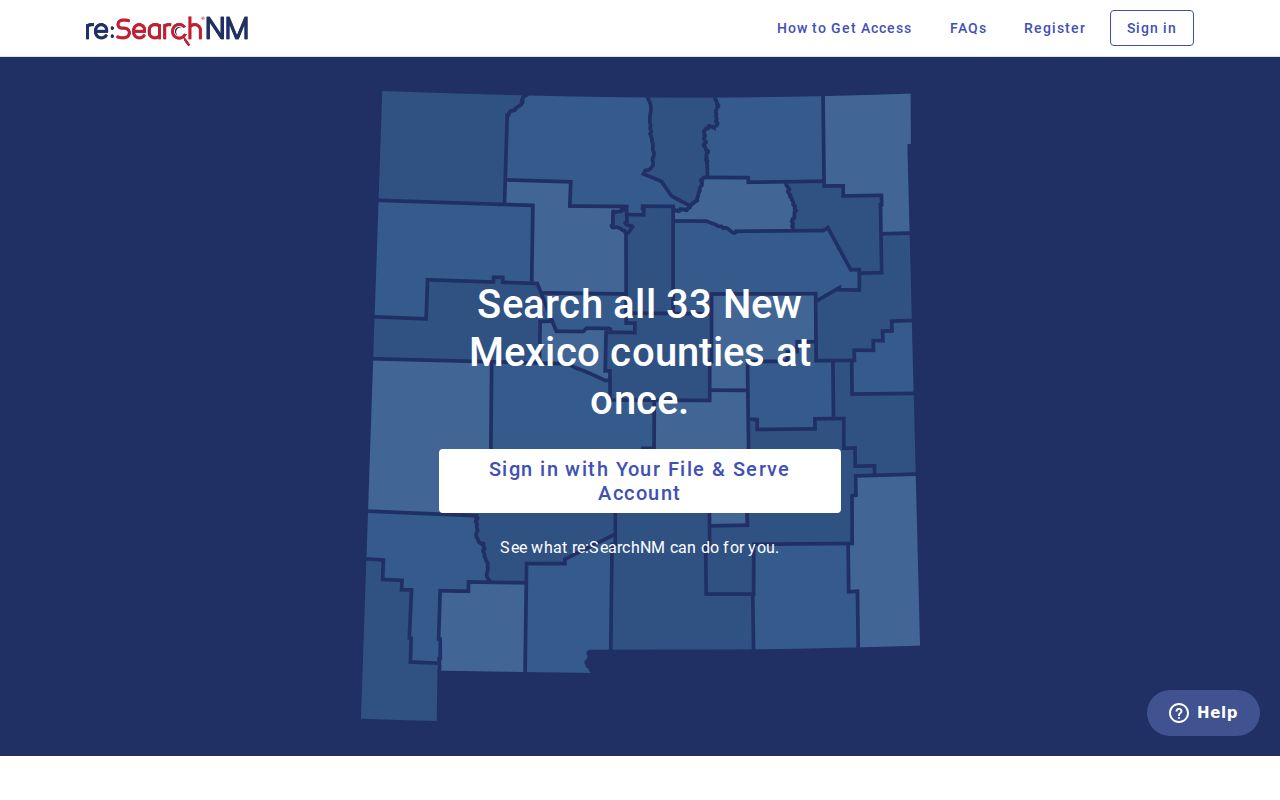
The screenshot shows the registered court-access route that supplements public docket lookup. It does not make restricted documents or suppressed address data available.
When the web result is not enough, Metropolitan Court offers a Records Viewing Room on the courthouse first floor and lists metrrecordscustodian@nmcourts.gov for records questions. Its posted copy price is $0.50 per page and certified copies are $1 per page. Use the case number and court location when asking for a copy. The Court notes that the Department of Public Safety, rather than the Court, is the official criminal-history repository.
South Valley Vital Record Routes
A birth, death, marriage, or divorce record answers an event question, not an address question. New Mexico’s Vital Statistics Act keeps modern vital records confidential. A birth record opens after 100 years only when the registrant is deceased, and a death record opens after 50 years. For recent records, the Department of Health requires an authorized applicant or tangible and direct interest. The Bernalillo County Clerk is the separate source for a marriage license issued by that county, while a district court keeps an underlying divorce decree and DOH provides a certified marriage or divorce verification record under its own rules.
The New Mexico death-record instructions show the eligibility and order route for that restricted record. The death application asks for requester contact and relationship information plus the decedent’s identifying event details. Direct mail requires the application, photo identification, and current payment instructions. Its published processing estimate is six to twelve weeks, so a researcher should not substitute an online name match for the custodian’s response.
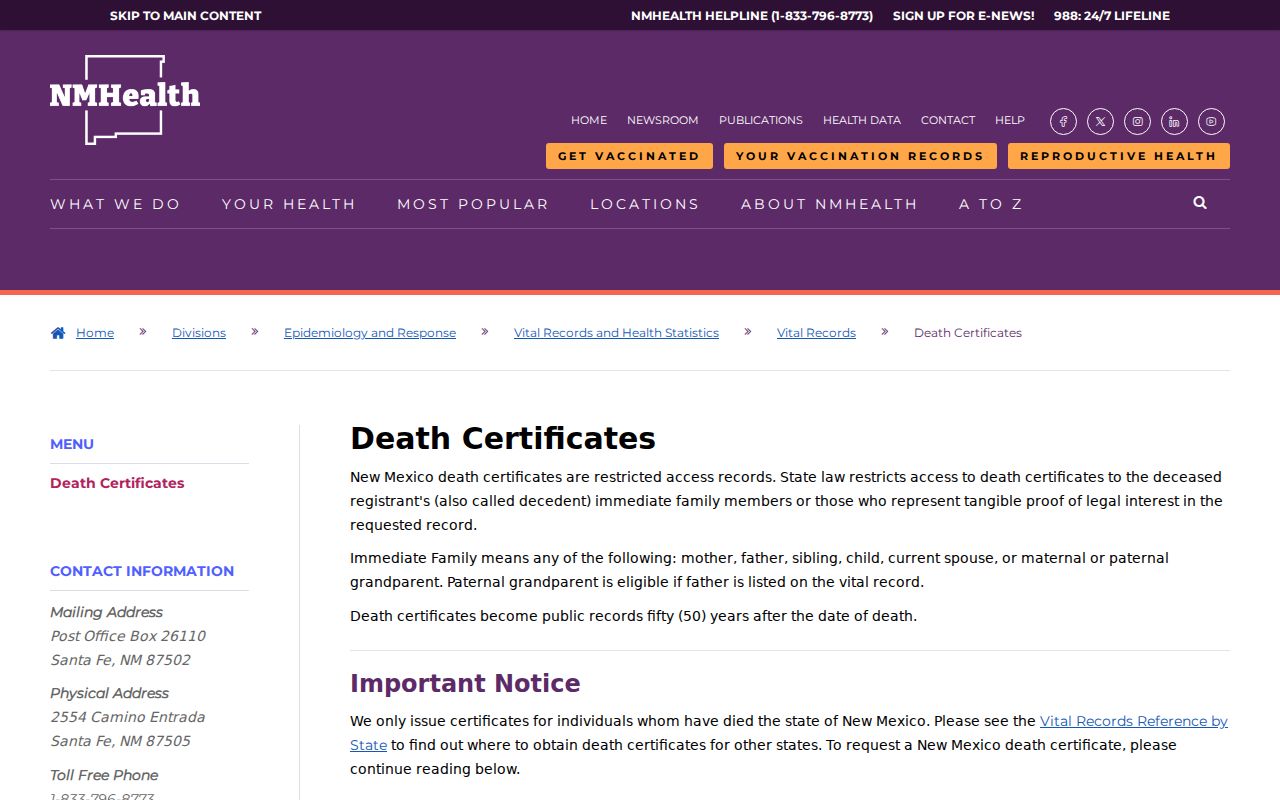
The image anchors the vital-record route in the State’s eligibility page. It reinforces that a certificate request follows a documented process rather than a public resident search.
For a birth certificate, DOH names immediate-family categories and people with tangible legal interest as eligible applicants. The posted birth search fee is $10 per certificate, payable by certified check or money order for mail requests. Midtown Public Health Office in Albuquerque is an in-person birth-record channel, subject to its current hours. Confirm current requirements with DOH before submitting an order, because a birth fee or office arrangement should not be carried over to a death-record request.
Note: A certificate request and a court-file request follow different access rules, even when both concern the same person.
South Valley Heir Record Trail
Estate and family-history research benefits from a narrow sequence of official and historical sources. For an heir question, an obituary or the Albuquerque Public Library Genealogy Center can supply a date range or family lead. The Genealogy Center reports obituary indexes and images for Albuquerque from 1888 through 2013 on its local network, along with other request paths for different periods. That lead can be compared with a probate case or recorded instrument, not treated as a complete statement of heirs.
Use the County Probate Court or district court for the estate-file path, following the court’s access rules. If an address is part of the question, retain the parcel’s legal description and move through the Clerk’s party roles and recording dates. Historical research may also use the City’s stated Albuquerque directory collection, which begins in 1908, and federal census records after their 72-year release interval. These sources can establish a documented chronology while leaving restricted modern vital records with the authorized custodian.
When a South Valley Search Stops
Some people leave no public online property or court trail. Renters, household members, utility customers, people who never owned property, juveniles, and parties to sealed records may not appear in a lawful public search. That is expected. Court systems suppress address information and other PII, while the Driver’s Privacy Protection Act limits motor-vehicle personal information. A missing record does not prove that someone has moved, has no connection to South Valley, or can be located through another source.
New Mexico Safe at Home is another important limit. The Secretary of State assigns qualifying survivors of domestic violence, sexual assault, or stalking a substitute address and helps agencies avoid disclosing the actual one. Voter records for participants receive separate protection. A result that is incomplete or ambiguous should not be combined with other data to defeat that protection. For a historical question, Special Collections, Main & Genealogy, UNM, or the State Records Center and Archives can be appropriate alternatives without being current-address sources.
Note: A custodian can explain its request process, but it need not create a tailored list of people for a requester.
Privacy in a South Valley Lookup
New Mexico law sets real boundaries around a name search. NMSA 1978 §1-4-5.5 limits voter-file data, and §1-4-5.6 provides criminal and civil consequences for knowing or willful misuse. The 2025 Nondisclosure of Sensitive Personal Information Act adds state-agency safeguards for covered sensitive personal information. An online assessment result that appears wrong should be raised with the Assessor; a recording issue goes to the County Clerk; court corrections follow court process; voter issues go to the Secretary of State; and vital-record changes follow DOH’s amendment process.
The June 2026 federal-court warning about fraudulent New Mexico traffic-citation texts offers a practical check: do not use a text link or payment demand as verification. Search a real case through the Judiciary’s published tools or contact the court through its published information. A displayed official detail can be copied into a scam, so independent verification matters.
South Valley Custodian Requests
When no portal has the needed County or City record, New Mexico’s Inspection of Public Records Act is the written fallback for records that are actually public. A request should identify the custodian, record type, address or document or case number, date range, and preferred inspection or electronic format. The statute does not require an agency to create a new resident directory. Under IPRA, access is due immediately or as soon as practicable and no later than 15 days after a written request. If access is not available within three business days, the custodian must send a written timing explanation.
For an incorporated-area City record, ABQ Records accepts online, mail, and in-person requests. Its notice asks for a name, mailing or email address, telephone number, and enough detail to locate the records. For a County document, call or email the Bernalillo County Clerk at 505-468-1290 or clerk@bernco.gov, or visit Recording and Filing at 415 Silver Ave. SW, 2nd Floor, Albuquerque. Give the document number, party name, date range, or legal description already established in the search.