
Finding South Valley Resident Records
South Valley does not have one government list of residents. It is a Census-designated place in Bernalillo County, and an address can fall in unincorporated county territory or in Albuquerque’s incorporated area. Start with the question you can document. A current parcel question begins with the County Assessor or Treasurer. A property-transfer question belongs with the County Clerk’s recorded-document index. An older family or address question may need an Albuquerque directory volume, newspaper microfilm, or an archive. Court and vital-record systems answer narrower questions and carry strong privacy limits.
The key distinction is between a person associated with a record and someone living at an address. An assessed owner, a deed party, a voter, or a court party may have a useful connection, yet none alone proves a current household. Keep the source, date, legal description, and party role together. That makes a South Valley residents directory search more reliable and avoids turning partial official records into a claim about everyone on a street.
- Confirm whether the street is in county territory or inside Albuquerque’s municipal record system.
- Search the Assessor or Treasurer by address, owner, or parcel number and save the situs and legal description.
- Use the legal description or parcel number in the County Clerk Kiosk, then note party roles, recording date, and document number.
- For an earlier household, request the closest available Albuquerque directory volume and check its actual street or alphabetical section.
- When a government-held record is absent online, make a narrow written IPRA request to its custodian rather than asking for a new household list.
Note: A focused record trail is more useful than a broad name search because South Valley addresses cross county, City, and postal systems.
South Valley Resident Records Offices
Most South Valley resident records are kept outside the CDP itself. The Bernalillo County Clerk holds recorded instruments and county marriage-license records. The County Assessor maintains the assessment roll and parcel context. The County Clerk also handles local election administration, while the Secretary of State supplies the voter-facing portal and controls the state voter-data process. For a City-held planning file, first verify that the address is in Albuquerque’s jurisdiction, then use ABQ Records or the City planning search.
Each office answers a different question. An Assessor result can orient a name to a parcel, but it is not live occupancy proof. A Clerk document can show who signed a recorded transaction and when. The election system is designed for an individual’s own registration, not a browsable roll. When an online result is incomplete, the counter, phone, and a narrow written request remain part of the official access route.
Bernalillo County Clerk
Recording and Filing
415 Silver Ave. SW, 2nd Floor
Albuquerque, NM 87102
505-468-1290
Bernalillo County Assessor
Property classification, value,
parcel, and assessed-owner records
Bernalillo County, NM
Verify current details with the office
Bernalillo County Clerk Elections
415 Silver Ave. SW, 2nd Floor
Albuquerque, NM 87102
505-468-1290
South Valley Address Jurisdiction
South Valley is a Census CDP, not an incorporated city with a single records counter. County property, deed, and election records often provide the starting trail. Some addresses also have Albuquerque planning or City Clerk material. A postal line that says Albuquerque does not settle that question. Check the parcel and applicable GIS source first, then choose the County or City access channel that actually holds the record.
The difference matters when an address search seems to stop. County Planning and Development assigns official addresses, and the County atlas is reference material rather than a legal-description source. City planning records apply only when the address is in City jurisdiction. A legal description from the County Clerk is the durable bridge when a street label, ZIP, or boundary label changes.
South Valley boundary tip. Keep the street quadrant, parcel identifier, and legal description with every result. Those details survive changes in postal or municipal labels.
South Valley Parcel and Deed Trail
The County Assessor’s public access system organizes property searching by address, owner, and parcel. Its disclaimer warns that assessment information can contain errors or omissions and is not real time. Use the result as the County’s current assessment context, not as a complete South Valley residents directory. The Treasurer’s property-tax search is a useful alternate path when it is available: it accepts address or parcel ID, has a tax-year filter, and gives wildcard guidance for parcel patterns.
From the parcel card, take the situs address, parcel identifier, assessed-owner name, tax year, and legal description to the Clerk Kiosk. The Kiosk can search a parcel number as well as subdivision, lot, block, tract, unit, and survey fields. That sequence is especially important for an older instrument where the current street address is absent or written differently. The full address chain is covered in greater detail in the South Valley street directory.
| Parcel | A defined property unit, often identified by a County parcel or property number. |
|---|---|
| Situs | The physical property location recorded in an assessment system. |
| Legal description | Lot, block, subdivision, tract, or survey wording used to identify land in official records. |
| Grantor / grantee | The party transferring an interest and the party receiving it in a recorded instrument. |
South Valley Clerk Index Searches
The Bernalillo County Clerk Kiosk is a name and legal-description index for recorded documents, with copy and certified-copy request functions. At inspection it displayed certified recorder documents from January 1, 1800 through July 6, 2026. That displayed range does not mean every early image or historic address is equally searchable online. When an index result is insufficient, use the Clerk counter, phone, or a records request to ask about a specific document number or legal description.
Exact-name searching is last name first with no punctuation. The portal also documents wildcard, quoted phrase, fuzzy, and proximity options. Use those tools carefully for spelling variants and then confirm the party role, document type, recording date, document number, book or page, and legal-description link. A name match by itself is not a verified identity match.
| Clerk Kiosk field | Useful South Valley search use | Format note |
|---|---|---|
| Name | Find indexed party entries | Exact name is last name first, without punctuation |
| Grantor or grantee | Follow a recorded transfer role | Use with date or legal-description details |
| Parcel number | Bridge from an Assessor record | Use the parcel identifier as displayed |
| Lot, block, tract, or unit | Find records when a street label fails | Legal-description fields can be combined |
| Recording dates | Narrow a document sequence | Use mm/dd/yyyy format |
South Valley Current Resident Sources
A current South Valley residents directory is assembled from separate official sources, each with a defined purpose. The Assessor connects assessed ownership to a parcel. The Clerk index records people and entities named in property instruments. Court dockets establish limited case information, not an address. The voter-facing portal is for the individual’s own registration. No one of these sources is a full household roster, and each should be checked against its own date and access rule.
| South Valley source | What it can establish | Custodian | Access path |
|---|---|---|---|
| Assessment parcel card | Assessed owner, situs, value, tax year, and parcel context | Bernalillo County Assessor | Public access after disclaimer |
| Tax account | Address or parcel tax context by selected tax year | Bernalillo County Treasurer | Public search when available, with counter fallback |
| Recorded-document index | Party role, recording information, and legal-description connection | Bernalillo County Clerk | Free index and copy-request path |
| Voter information | An individual’s own registration and election information | New Mexico Secretary of State | Identity-checked voter portal |
| Historical directories | Past address and name leads where a volume covers the place | Library and UNM collections | Request the specific volume or collection |
Use a source that matches the question. A one-person trail may start with an owner search and then require a recorded document or court result to sort out a same-name match. A historical address needs a dated directory or archive source. Name-to-record work requires two independent points of confirmation.
South Valley Court Record Routes
New Mexico Case Lookup is the Judiciary’s no-registration route for docket information from several court levels. It does not provide court documents and suppresses address information and other personal identifiers. For an older-than-1997 record, the Judiciary directs researchers to a request route. The registered re:Search NM system offers tiered access under its own application, terms, and access policy. A court hit does not establish where a person lives now.
The official New Mexico court access instructions explain the distinction, while Metropolitan Court offers a Records Viewing Room for an in-person alternative. Capture court, party spelling, case number, filing date, type, and status, then corroborate from an independent official record. The panel below shows the Judiciary’s public-access explanation.
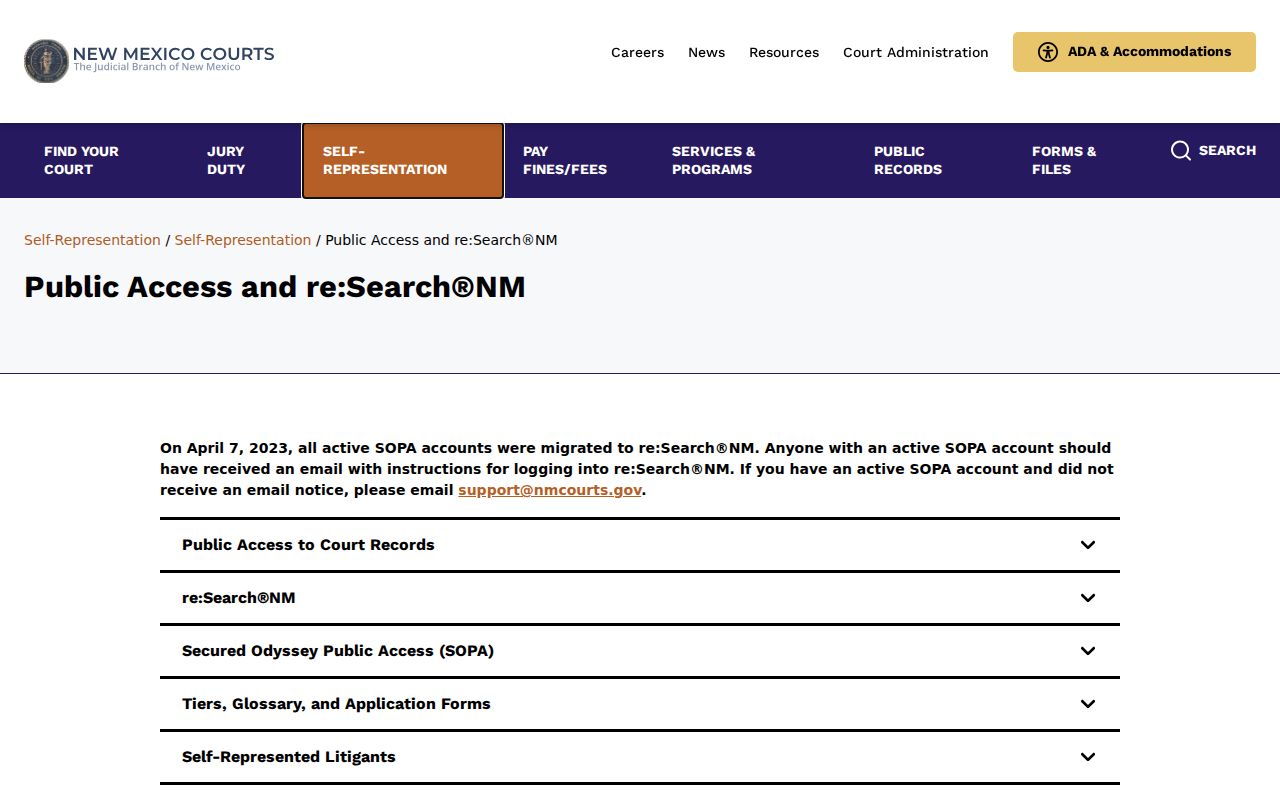
That access structure is why a South Valley docket search is useful for a defined case question but cannot substitute for a resident roll.
South Valley Vital Record Boundaries
New Mexico’s Vital Statistics Act keeps modern vital records confidential. The Department of Health issues certificates only through its eligibility process. Birth records become open after 100 years only if the registrant is deceased, and death records become open after 50 years. County-issued marriage licenses and court divorce files follow separate custodian paths. A family-history question should begin by identifying the event, the approximate date, and the office that holds that specific record.
For a modern birth request, the Department of Health requires an eligible immediate family member or documented tangible legal interest and uses its application, identity documents, and payment process. The official birth-record information is the source for the current requirements. For earlier family research, SRCA finding aids, church microfilm, obituaries, and directory volumes can provide leads without bypassing certificate rules.
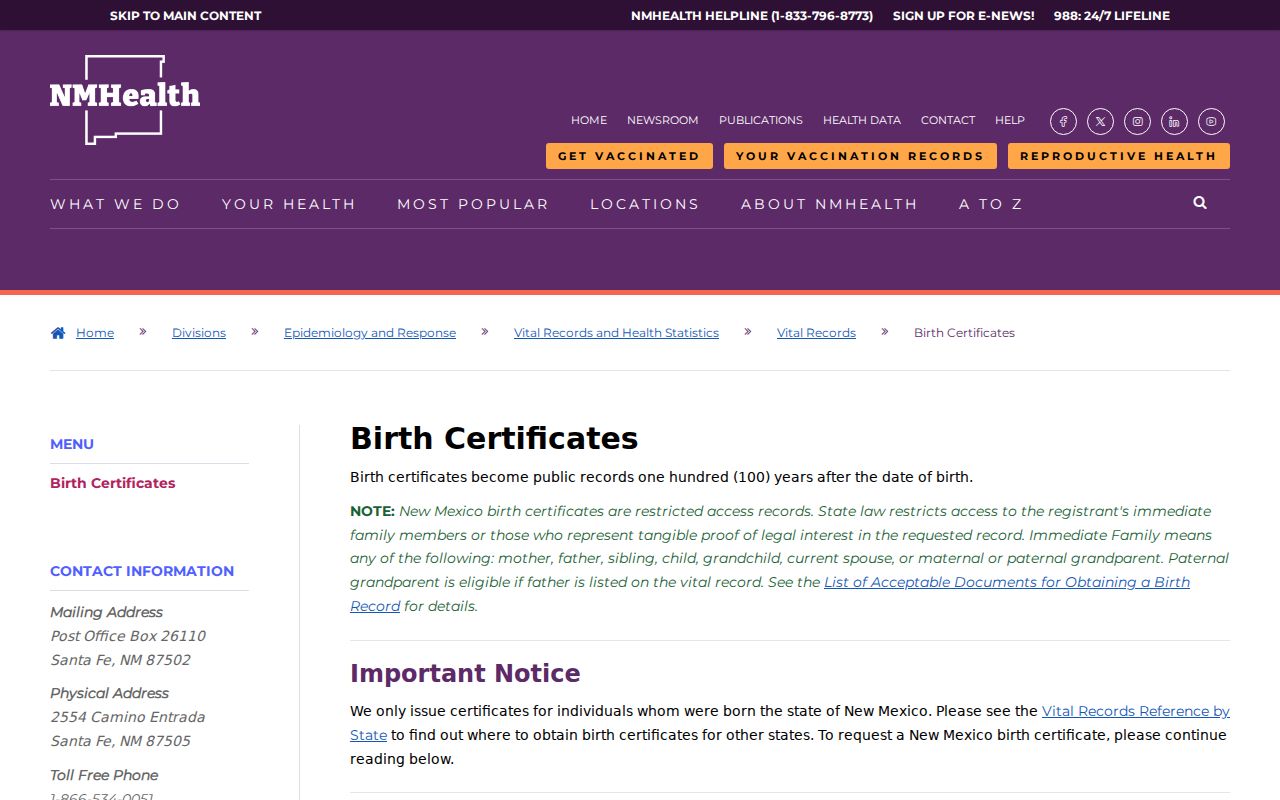
The Department of Health material belongs in an event-record search, not in a broad South Valley name lookup.
South Valley Voter Record Limits
The New Mexico Voter Information Portal is for a voter’s own registration, ballot, and polling-place information. Official instructions describe first name, last name, date of birth, and county as the lookup path. It is not a public way to browse a South Valley street. Authorized voter data is a different process under NMSA 1978 §1-4-5.5, involving a written request, authorization, payment, and restricted use. Protected fields and Safe at Home information remain out of reach.
The Voter Information Portal remains useful for the limited purpose it serves. For local research, use aggregate registration statistics by district or precinct when names are not needed. The illustrated portal makes the identity-checked format clear.
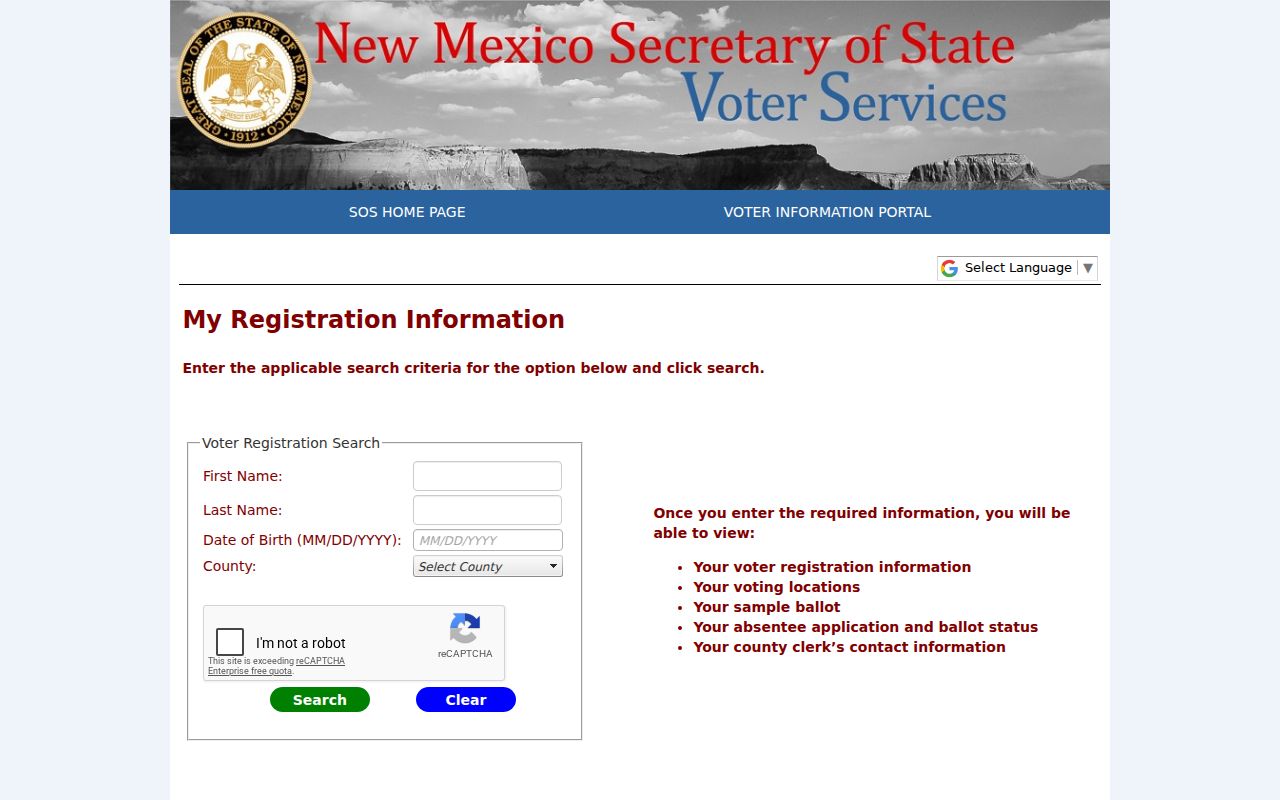
Using a restricted civic record as if it were a general resident list would misstate both its access rules and its purpose.
South Valley Records Request Fallback
When a County, City, or state custodian has a defined public record that is not online, New Mexico’s Inspection of Public Records Act is the fallback. A written request should name the requester, provide contact details, and describe the record with reasonable particularity. IPRA does not require an office to create a custom South Valley residents directory. Ask for a document number, address, date range, case number, or record class that the custodian can locate.
Under the statewide timing rule, inspection is due immediately or as soon as practicable and no later than 15 days after receipt. If access will not occur within three business days, the custodian must provide a written timing statement. Albuquerque’s ABQ Records portal also offers online, mail, and in-person request channels for City-held material.
The portal is a City access channel only, so an unincorporated South Valley record may instead belong with a County custodian.
Note: Narrow requests help the custodian find existing records and reduce the chance that an address or agency-jurisdiction mismatch delays a response.
South Valley Historical Resident Directories
There is no verified stand-alone South Valley city-directory series. The documented historical shelf is Albuquerque’s city-directory run, identified by the City as 1908 to present and held through Albuquerque Public Library and the University of New Mexico Center for Southwest Research. That is a collection lead, not a promise that every volume contains every unincorporated South Valley address. Ask for a named year and inspect the actual book’s alphabetical, street, or reverse section before drawing a conclusion.
Main & Genealogy Library and Special Collections supply different historical access paths, while the nearby South Valley Library is a useful starting point for library help. A directory can provide a spelling, address, notation, or time window. Pair it with a deed, census-era source, obituary, or archive record. The complete collection and entry-reading method is in the South Valley directory book.
South Valley State Affiliation Records
Some official state tools verify a limited affiliation instead of a residence. The Secretary of State Business Services search accepts an entity name or business ID and can show filing history and status. The Regulation and Licensing search can verify an appropriate professional license. An entity office or agent address is not a home address, and an official result should be used only for the particular affiliation it documents.
The New Mexico Secretary of State Business Services screen is a direct route for a defined entity query. It is not a people directory and should not be used to turn a name into a South Valley address claim.
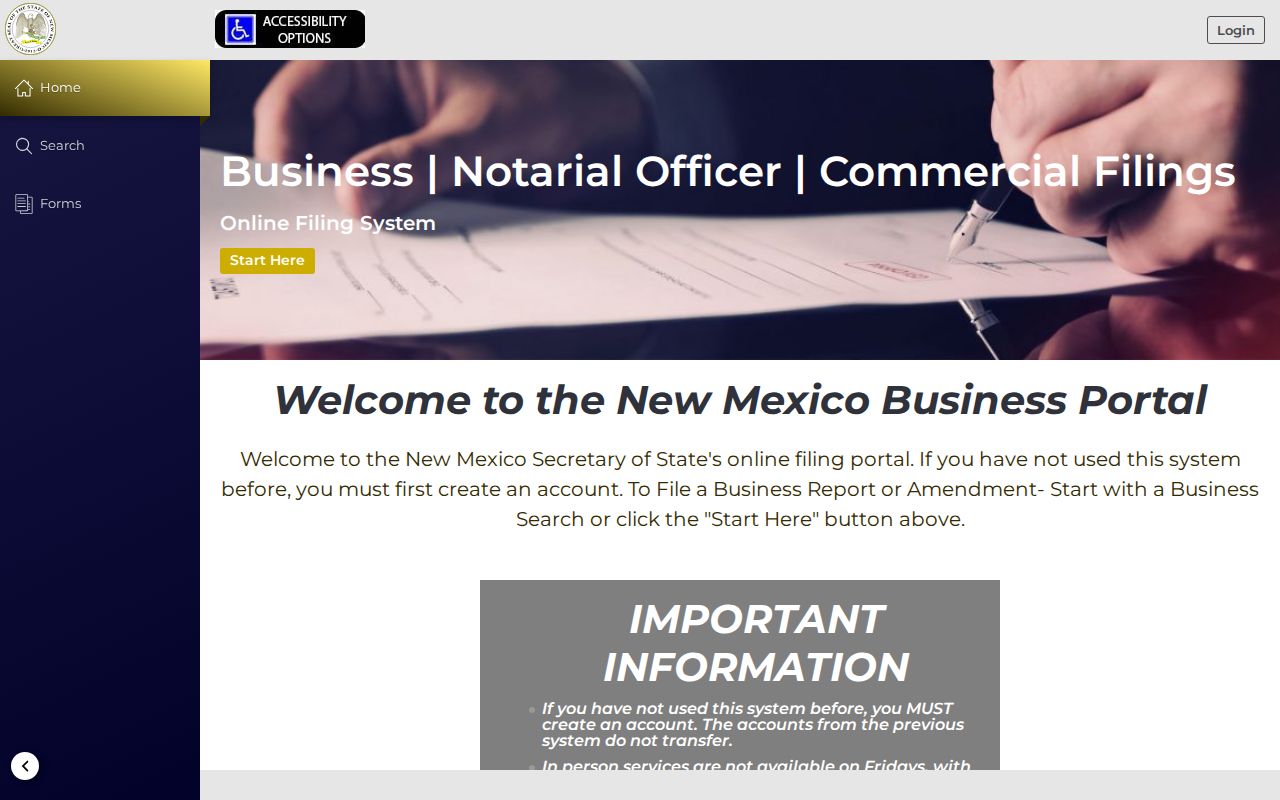
The search is valuable when a public filing is relevant, but the filing field and the person’s residence are separate facts.
South Valley Custody Search Limits
New Mexico Corrections Department Offender Search is a state system for adult prison and probation or parole information. Its starting fields are first name, last name, or NMCD number, and the Department warns that Adult Prison Division information updates nightly while probation and parole information update in real time. It does not cover county or city detention. A South Valley inquiry about Bernalillo County custody must use the Metropolitan Detention Center’s published contact process instead.
The official NMCD Offender Search is a status lead that requires direct verification with the institution or supervising office. A result or no result is not evidence of a person’s current address or a substitute for records held by the appropriate local custodian.
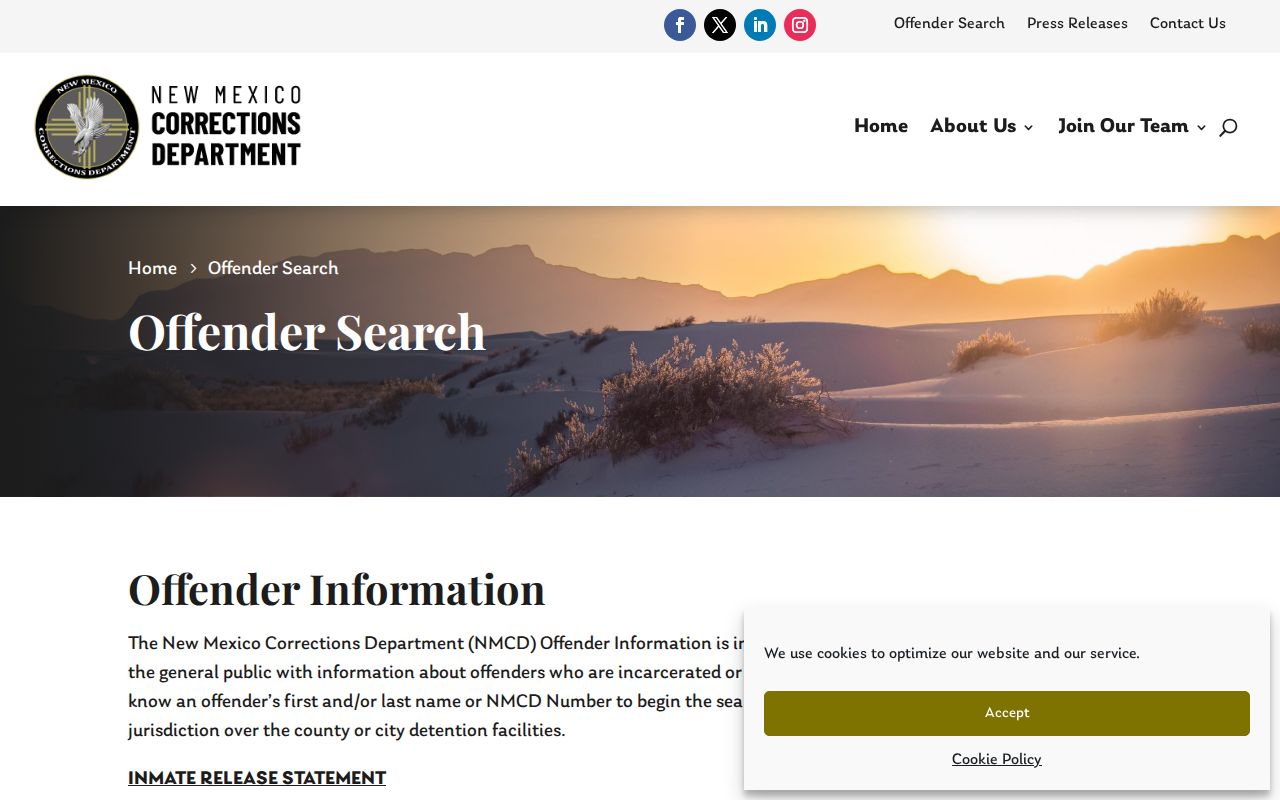
Keeping the state and county custody systems separate avoids sending a South Valley researcher to a database that cannot answer the local question.
South Valley Protected Address Rules
Gaps in a South Valley resident record can be deliberate protections. New Mexico Safe at Home gives qualifying participants a substitute address and limits disclosure of actual location details. Court Case Lookup suppresses address information. Vital records, juvenile and sealed material, and restricted voter information also have separate rules. A missing address does not establish that an office made an error or that another system should be used to expose it.
Use official records for personal, lawful research and stop when a custodian or program protects information. If an assessment, recorded-document, or court record appears wrong, take the parcel number, document number, or case number back to the agency that created it. The custodian, not a directory, can confirm, correct, or certify a record.
Privacy limit. Do not use any record path to stalk, harass, threaten, or harm a person, and do not try to defeat a protected-address program.